
Postscript on the Xi–Trump Summit: After the Summit Is Before the Summit

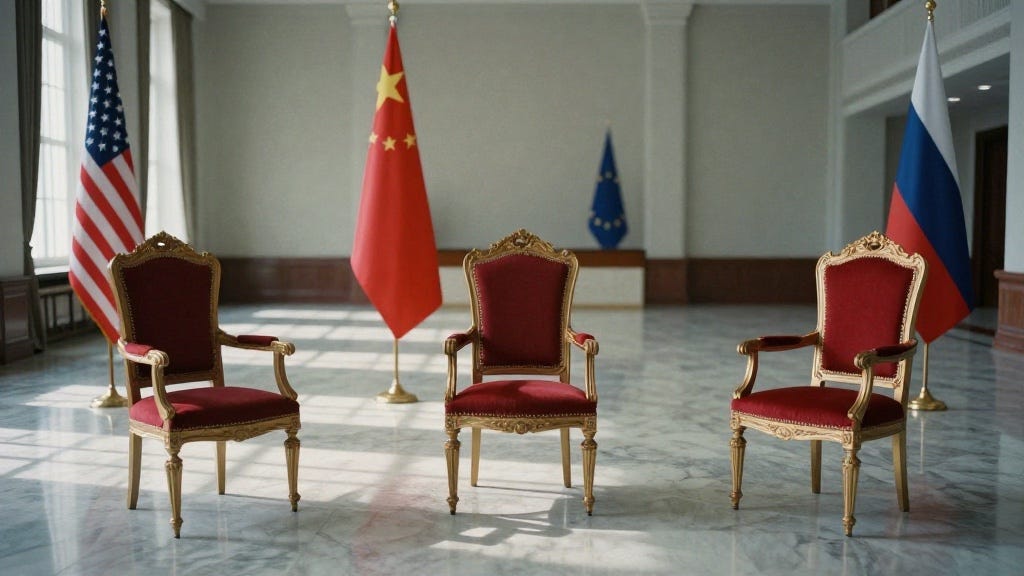
“Constructive strategic stability” is the central term from Beijing’s perspective. The idea is not that competition disappears, but that it is bounded by limits, rules, and political guardrails. At its core, this is about controllable competition. One could read it as a way out of the binary logic of hegemony or defeat: for the United States, a dignified path into a multipolar order, neither humiliating retreat nor a futile attempt to keep encircling China. Less optimistic voices see it less as an objective diagnosis than as Chinese self-positioning: the United States appears as an insecure, fragmented actor, while China increasingly casts itself as a global peace promoter.
Even so, the Trump-Xi Summit from May 14-15, 2026, was neither a reset nor a victory for Washington or Beijing. It did, however, buy Beijing time and predictability. The summit’s greatest value probably lay in preventing a “vertical free fall” in the relationship: not resolution, but collapse avoidance. At the same time, it opened a window for operational understandings, limited residual cooperation, and the proper handling of differences. The decisive question is whether shared interests can in fact outweigh the divergences. After years of downward spiral, the summit could also be read as a “new floor” for the relationship.
Beijing understands that Trump thinks of “constructive” and “stable” primarily in trade terms: reciprocity and deals. Beijing reads the same terms more strategically: restraint, competition management, escalation control. The term also resists Western framings of spheres of influence and inevitable great-power conflict, because it does not allow China and the United States to be thought of separately; the two are deeply entangled. This raises the question of whether transactional stability can be reliable: Trump can make deals, but can a stable China policy be built out of them?
Both sides quickly find themselves caught again in the three forces that make this meeting historically significant: systemic constraints, mutual entanglements, and tactical fields of conflict. In Paris, at the G7 finance ministers’ conference, Scott Bessent called on the international community to join U.S. sanctions against Iran, while his Treasury Department allowed continued Russian oil flows for another 30 days in order to stabilize the market for Americans. Some believe that Beijing had secured de facto non-interference on Taiwan and continued access to second-tier chips, in exchange for an assurance that it would not deliver weapons directly to Iran. This is not publicly substantiated. But as an interpretive offer, it fits precisely into the pattern of systemic constraint and mutual entanglement.
The summit can perhaps be summed up as follows: Washington did not push through a new China strategy. Rather, for the first time in a long while, it accepted a framework set by Beijing; a framework in which competition remains permissible, but no longer functions as a unilateral American right to discipline China.
From a Berlin perspective, where I am located, the meeting can also be read this way: the United States and China are moving closer, while Europe and China are drifting apart. Trump returned without a heavy deal bag — certainly without excess baggage. Beijing offered him ceremony rather than core concessions, while Europe is moving in the opposite direction: the European Commission is further preparing a tougher China line focused on trade deficits, overcapacity, and the protection of European industry. For Europe, China remains less a negotiating partner in summit theatre than a competitor over the industrial base.
Putin is with Xi in Beijing today and tomorrow, and it is precisely the proximity to the Trump summit that makes the visit interesting. The official occasion is the 25th anniversary of the 2001 China-Russia Friendship Treaty. Moscow is signalling expectations of a larger oil and gas deal, because since 2022 China has become Russia’s decisive export market, financial lifeline, and political backstop. But the leverage lies in Beijing: Russia needs China more than the other way around. Xi can demonstrate closeness to Putin without rupturing the U.S. track he has just stabilized. Beijing is testing how far it can hold transactional stabilization with Washington and strategic insurance through Moscow in parallel. This is a precise double movement: stabilization with Trump certainly does not mean distancing from Moscow, and Beijing’s room for manoeuvre grows precisely where Washington itself becomes more transactional.