
Stability Without Change: Reading the Trump-Xi Readouts
The Beijing summit did not reset U.S.-China relations. It clarified the new operating logic: strategic stability for Beijing, and U.S. pressure that no longer comes without cost.

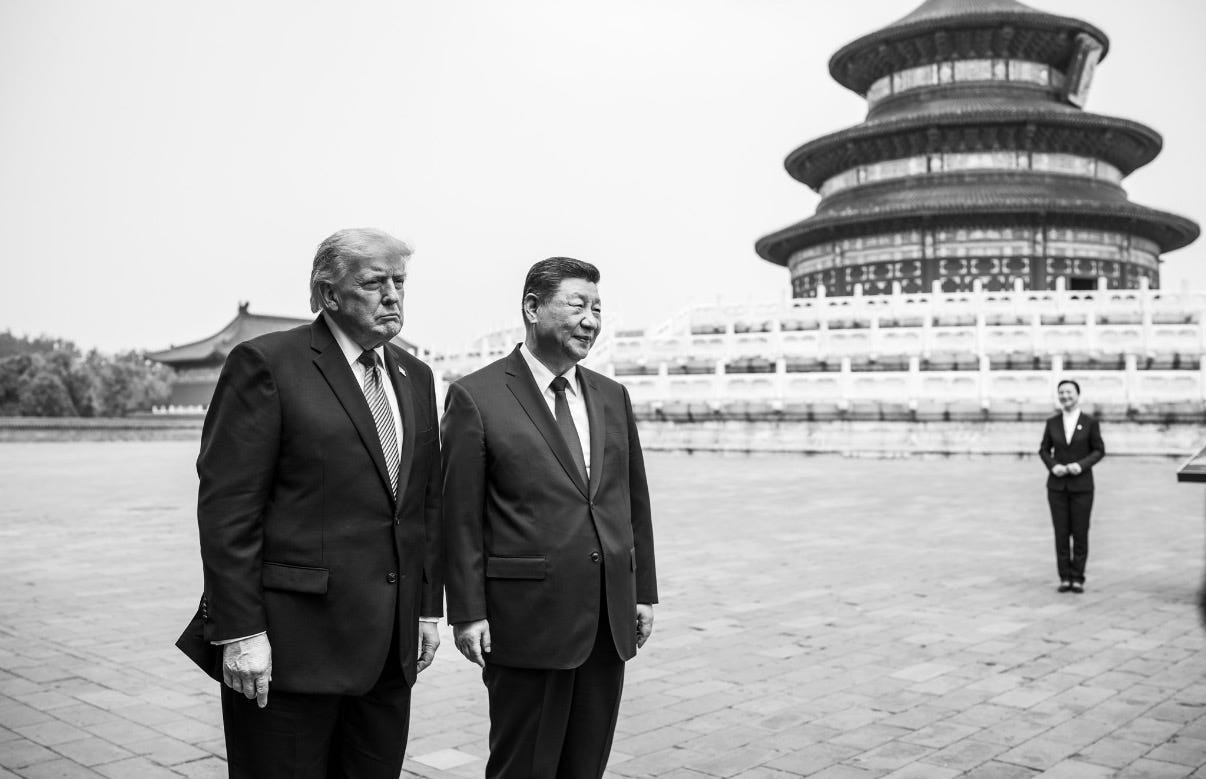
The Trump-Xi summit in Beijing produced what was possible, not what either side ultimately wants: enough stability to claim progress, not enough substance to change the rivalry.
The readout asymmetry is the real outcome. Beijing framed the meeting as a step towards “constructive strategic stability” and placed Taiwan, core interests and long-term management at the center. U.S.-side messaging emphasized trade, Iran, business cooperation and tactical deliverables. Both sides could claim enough progress, but they were not measuring success in the same way.
The symbolism prior to the visit carried that asymmetry. The submarine bell given to Trump by King Charles was read in the West as ceremony and wartime memory. In Chinese commentary, however, the gift was decoded through the homophone song zhong — “giving a bell,” which can also sound like accompanying someone to their end. Whether overread or not, the episode captured Beijing’s wider interpretive mood: the summit was not happening inside the old hierarchy, but inside a debate about whether that hierarchy is already passing. What Suez was for Britain in 1956, Hormuz could be for the United States: the moment when an imperial power discovers that military reach no longer equals geopolitical command.
This was not a reset. It was a managed pause.
The Chinese readout matters because it defines the strategic ceiling of the relationship. Xi’s message was not that China and the United States are converging. It was that rivalry must be stabilized on terms that recognize China’s core interests and the costs of U.S. pressure. The language of “partners, not rivals” is therefore not simply conciliatory. It is a claim to parity.
The summit should be read through three layers.
Mega-constraints, the cause. Neither side arrives free. The United States is constrained by debt-financing dependence, dollar-power credibility, reindustrialization pressure, technology-primacy imperatives, military-security inertia, Middle East exposure, alliance credibility and domestic deal politics. China is constrained by export dependence, weak domestic demand, energy and food-security exposure, employment risk, sovereignty red lines and the need to position itself in a post-unilateral order. These are the causes. They explain why neither side can simply de-escalate without cost.
Mutual entanglement, the complex. Those constraints are lived through mutual dependency. The U.S. has demand power, dollar power, sanctions, chips, military reach and alliances. China has production power, critical minerals, batteries, magnets, industrial inputs, manufacturing depth, supply chain dominance, market access and counter-compliance tools. The old assumption was that interdependence made China vulnerable to U.S. pressure. That is still partly true. But the relationship has become a complex of counter-dependence: American pressure remains real, but China can increasingly return costs through the same system.
Friction points, the symptoms.
Taiwan, Iran, rare earths, technology controls, sanctions and trade are not separate agenda items. They are the symptoms: the visible places where the deeper constraints and the entangled complex break through into politics.
Taiwan is the clearest example. The Chinese readout put it at the center. U.S. messaging did not. That is not a detail. It shows the two sides managing the same meeting through different political hierarchies: Beijing begins with sovereignty; Washington begins with deliverables desperately calibrated for Trump’s approval rating and the midterm elections at home. Under Trump, Taiwan also risks appearing less as a fixed strategic commitment than as a bargaining chip inside a larger deal-making frame. But the deeper U.S. logic remains structural: Taiwan is part of the first island chain and a key obstacle to China’s unfettered access to the Pacific.
Iran and Hormuz add a different layer. Trump said Xi offered to help on Iran and keeping the Strait of Hormuz open. Chinese readouts were more cautious. China wants de-escalation and safe passage, but not the role of subcontractor to a crisis Washington has created. Iran may blink first under economic strain from sanctions, financial isolation and disrupted trade routes. But that would not make China a subcontractor to U.S. pressure. Beijing’s preferred frame remains multilateral and regional: de-escalation, safe passage and political settlement without stepping into America’s interventionist role. China’s May presidency of the UN Security Council provides the template: multilateralism through the UN Charter, political settlement in the Middle East, and regional ownership in Africa.
Rare earths were the previous proof point, but the summit pointed to something broader. The billionaire delegation did not come only to discuss trade deals, tariffs or minerals; they came to see a China that has advanced across the critical layers of the industrial stack, the very capacity the U.S. is struggling to rebuild. Washington can still restrict chips; Beijing increasingly controls the systems where technologies become factories, supply chains and scale.
So what changed in Beijing?
Tone, not structure.
The summit stabilized the language of rivalry. It did not resolve the rivalry. It confirmed that both sides need a managed relationship, but for different reasons. Despite all friendliness, Trump needs to show that pressure still produces results; Xi needs to show that pressure has limits, and that even such a lavish welcome in Beijing now comes at a cost. The Mar-a-Lago precedent matters: personal warmth in 2017 did not prevent the tariff war of 2018. With Trump, tone is not structure.
That is why “constructive strategic stability” is the real headline. It does not mean trust. It means managed conflict under conditions of mutual vulnerability.
For Europe, the lesson is uncomfortable. It was clear that the U.S.-China relationship is not moving back towards the old globalization model. It is moving towards a system in which both powers keep trading, negotiating and staging stability, while hardening their leverage over supply chains, technology, sanctions and market access. The war in Ukraine may continue for an unforeseeable time, and so may the war against Iran, with no easy off-ramp in sight for Trump.
They may meet again at the G20 in the United States later this year. By then, a lot of water must passed through the Strait of Hormuz and the Taiwan Strait. Iran, Taiwan, rare earths, sanctions and technology controls will not wait politely for the next summit calendar. Nor will China’s agentic industrial upgrading wait: compute-efficient tokens will be converted into factory coordination, engineering workflows, supply-chain optimization, robotics, quality control and industrial design.
What was said in Beijing will only be measured by action, yet “strategic stability” provides more constrictive guidance than strategic rivalry, competition, or decoupling. Maybe it’s a “new floor under the downward trend.” Next, Putin will meet Xi in Beijing within days, placing the U.S.-China channel back inside Beijing’s wider strategic geometry.